
Research
We improve mobility by combining traditional ideas, such as traffic flow theory and safety modeling, with frontier technologies, such as emerging driving technologies and AI.
Our approach
What sets MOTIF apart is a synergistic view. We integrate traffic flow theory with driving technologies and AI, because we believe technology guided by domain knowledge is the solution.
Our work is organized in three themes, and most of our papers sit where two of them meet.
21 of 28 papers span two or more themes.
Where the themes meet
- Traffic flow + vehicle technologies
- Vehicle technologies + AI
Scale-CDA: a scalable prototype to democratize AI-assisted cooperative driving automation (CDA) for production cars
- Traffic flow + AI
Congested urban networks tend to be insensitive to signal settings: implications for learning-based control
- All three themes
Implications of stop-and-go traffic on training learning-based car-following control
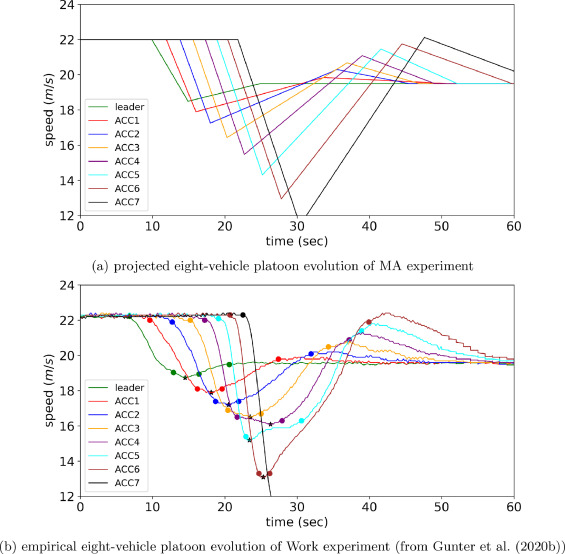
Theme 1 · 13 papers
Traffic flow theory and operation
Macroscopic and microscopic models of how vehicles aggregate into flow, congestion, and breakdown, and how those models guide traffic operations.
Questions we ask
- How do ADAS and electric vehicles change bottleneck capacity and the spread of stop-and-go waves?
- How do human drivers respond to automated vehicles, for example when cutting in front of them?
- When do classical traffic models still hold in mixed traffic, and what minimal extensions make them predictive again?
Recent papers
Cut-in gap acceptance toward autonomous vs. human-driven vehicles: evidence from the Waymo Open Motion Dataset
Empirical characterization of electric vehicle acceleration: implications for lane changes and traffic bottleneck capacity
String instability mitigation of adaptive cruise control without modifying control laws: trajectory shaper and parameter estimation
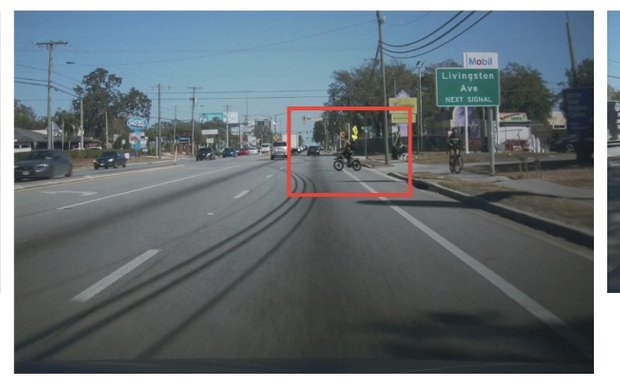
Theme 2 · 25 papers
Emerging vehicle technologies
How ADAS, lane-keeping assist, and electric powertrains change traffic efficiency and safety at the system level.
Questions we ask
- How well do production lane keeping and adaptive cruise control actually perform on public roads?
- When and why do drivers take back control from driving automation?
- How do these systems change safety and efficiency once many cars on the road have them?
Recent papers
DriveDNA: a large-scale multimodal naturalistic driving dataset and benchmark for driving style identification
BATON: a multimodal benchmark for bidirectional automation transition observation in naturalistic driving
ADAS-TO: a large-scale multimodal naturalistic dataset and empirical characterization of human takeovers during ADAS engagement
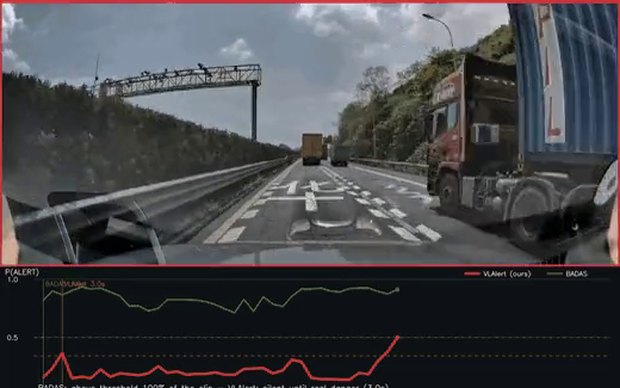
Theme 3 · 13 papers
AI for mobility
Emerging AI, including language models, world models, and AI agents, applied to traffic operations, driving safety, and agency needs such as road damage inspection.
Questions we ask
- When should an in-car system stay silent, keep watching, or alert the driver?
- Can one model forecast the driver, the vehicle and the road together, in real time?
- How can language models and AI agents help agencies inspect roads and run daily operations?
Datasets: DriveMotion VLAlert-Bench TriDrive
Recent papers
All 29 papers, the data behind them, and how to work with us: